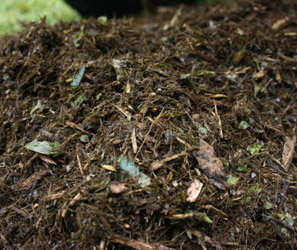
Fermentation prisms should be (regardless of the season) protect against drying out or freezing, covering them on each side with straw mats or foil. The foil is placed around 20 cm above the prism base, to maintain proper aeration of the fertilizer. You also have to pay attention to leaks from under the prism, indicating correct or incorrect wetting of the fertilizer. The leaks should be approx 30 cm. If the fertilizer in the heap does not heat up to the desired temperature,. 75do temp, check its humidity, as the reason can be both too big, as well as insufficient hydration of the prism. Fermentation can be improved by adding molasses dissolved in water (4…5 kg in 1000 kg of fertilizer) or sugar (3…4 kg in 1000 kg of fertilizer). When the prism freezes, you can try to warm it up with steam or mix warmer layers of fertilizer with cold ones.
In case the required temperature is not obtained, you have to take into account a reduction in yields.
Before placing the fertilizer on the shelves, its acidity is laboratory tested (pH) and humidity. Optimum pH value 8…8,2, optimal humidity 71 …73%. Laboratory services for producers from all over Poland are performed by mushroom laboratories located in individual provinces, and also Agricultural Academies. The next step after fermentation is the pasteurization process (lasting 5…12 days, depending on the method), bringing fertilizer to this form, which creates optimal conditions for the development of mushroom mycelium, a prevents the development of competing fungi. The individual phases of pasteurization take place at the following temperatures: Phase I – 58…60do temp (ok. 12 h), Phase II – 58…48do temp (until the ammonia is gone). When pasteurizing, pay attention to:
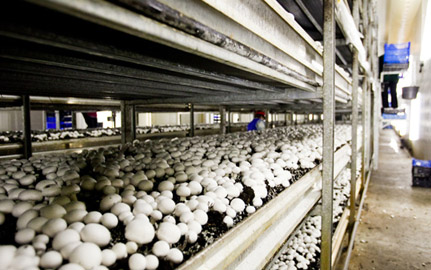
– even distribution of the fertilizer on the shelves to a thickness of 25…35 cm (then the fertilizer heats up well and does not dry out);
– correct placement of thermometers in the compost (at least on two different shelf levels) and one in the air in the center of the hall.
After the pasteurization process is completed, the fertilizer should be tested in a laboratory for the presence of diseases and pests as well as its acidity (correct acidity pH = 7,5), humidity (66…68%) and ammonia content (0,05%). The fertilizer should be delivered for testing in tightly closed foil bags (after approx. 0,5 kg).