Nest frames and overhead hive frames.
As it results from the conducted research, frames of spruce wood should not be made. Pine wood is well suited for the frames, as long as it is not too high in resin and is not blue or huby. The slats on the frames must not have knots. Hoffman type side bars ensure easy operation and prevent any movement of the frames during transport.
Performance Notes (collected by points consistent with the numbers of frame elements listed in the table and in the figure.
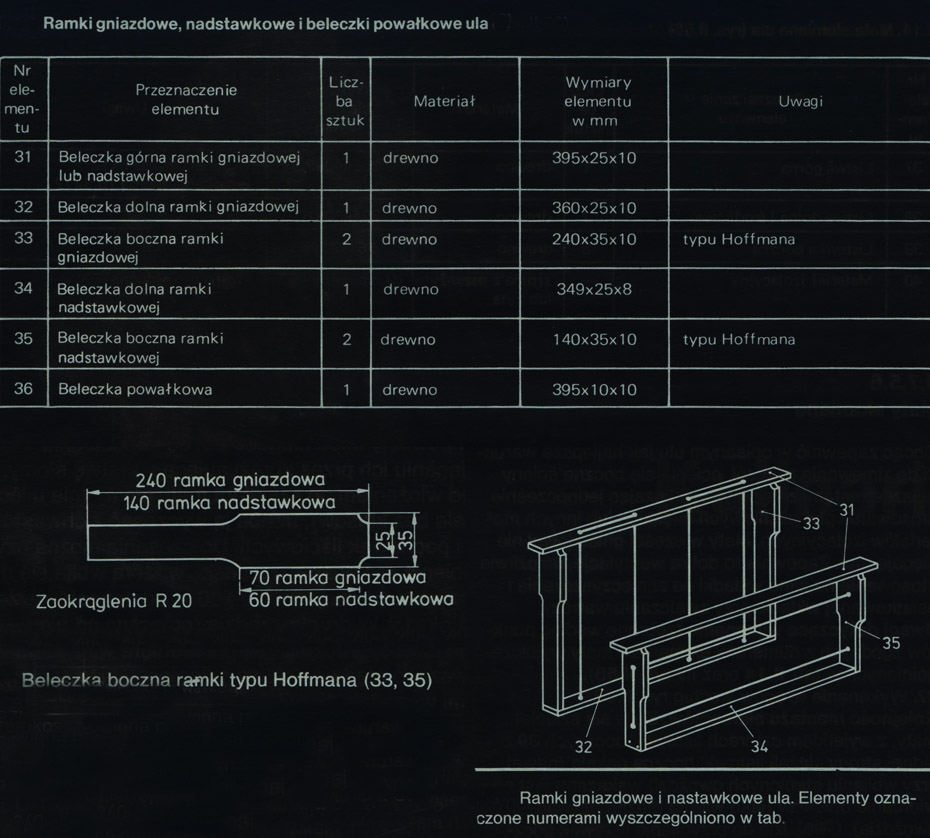 31, 32, 34. Beams with the given dimensions should be cut from sawn timber 25, two-sided planed on a circular saw equipped with a fine saw, slightly apart teeth. The boards must first be cut to the correct length, and then cut the slats from them.
33, 35. The side bars are cut on a circular saw, from thick lumber 35, planed on both sides, and then they are shaped according to the drawing.
36. In addition to the bars given in the list, it is good to have a number of bars that are half as narrow, i.e.. with dimensions of 395x10x5.
The order of assembly of elements. The order of breaking the frames is basically arbitrary. However, it is good to make an appropriate form for this purpose, which will greatly facilitate the work and ensure the accuracy of execution. It is important to, make the length of the protruding parts, on which the frame rests when inserted into the hive, it was equal and equal to 17,5. Nest frames are wired vertically like this, To get 4 wires in the frame light. Stainless wire in diameter 0,4 it is wrapped on nails hammered into the frame bar, stretching it like this, so that it does not bend the frame beams. The edge wires are distant from the side bars by 35, and the rest deployed at 90 (counting from the side wires). Overhead frames are wired horizontally like this, so that there are two wires in the frame light, distant from the bar of the upper and lower frames by 35.