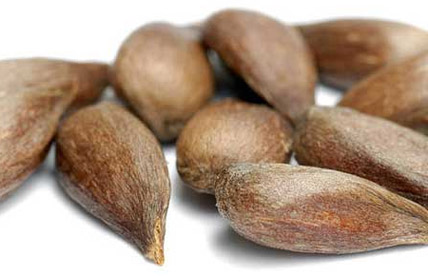
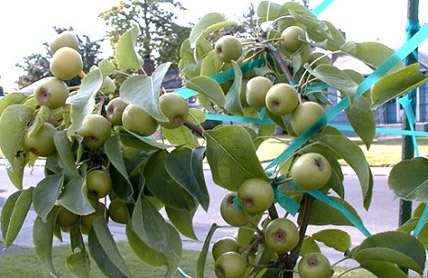
GENERATIVE REPRODUCTION AND ITS MEANING. The production of generative rootstocks is based on skillful harvesting, preparation and sowing of seeds and proper care of plants from the moment of emergence to the achievement of a specific nursery suitability. We produce rootstocks for all kinds of fruit trees in a short time from seeds. The disadvantage of generative rootstocks is the high variability of the features, especially inadequate leveling of growth force, disease resistance and frost resistance. The generative rootstocks of pome trees are free from economically dangerous viral diseases, while the rootstocks of stone trees can be infected with viruses, because some viruses are transmitted by pollen and seeds.
VEGETATIVE REPRODUCTION AND PRACTICE METHODS. Vegetative reproduction is based on the skillful division of the vegetative parts of the mother plant. This method reproduces selected types of rootstocks of pome and stone trees as well as all fruit trees and shrubs.. We distinguish between several ways of vegetative reproduction, namely, reproduction by:
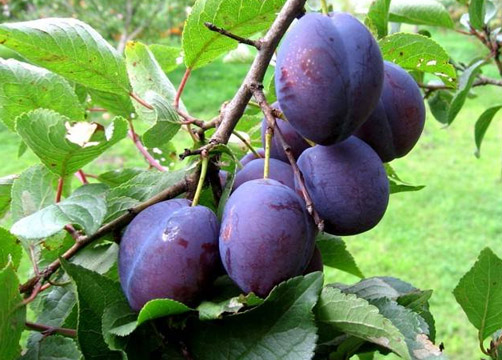
In practice, propagation by root suckers and division of mother plants is very rare. Raspberries are propagated from root suckers, sometimes local types of cherries (the so-called. juices) and various types of ordinary Hungarian, especially in the Podkarpacie region. Propagation of plums by root suckers is undesirable at present, because it promotes the spread of the most dangerous viral disease – sharks. Sometimes only wild strawberries are propagated by dividing the plants.
Reproduction by layering is most often used in the production of vegetative rootstocks. We distinguish between multiplication by vertical layering (kopczykowa-no) and horizontal dumps. In order to propagate rootstocks using these methods, it is necessary to establish a mother plantation (lair).
Propagation by mounding consists in covering the shoots growing from the mother plant with soil. In this way, we mainly propagate vegetative rootstock for apple trees and quince rootstock. Vegetative rootstocks for stone trees are usually propagated by horizontal dumps: plum, sweet cherries and cherries. Young shoots grow vertically upwards from last year's shoots bent to the horizontal position, which, after being covered with earth, take root. Autumn shoots rooted in vertical and horizontal places are cut off and used for the production of trees.
Propagation by cuttings involves cutting the vegetative organs of the plant: momentum, the root, of the leaf or the apex of growth into specific parts and creating favorable conditions for them to take root. The main factors contributing to rooting are: quite high temperature and humidity, appropriate composition of the medium and the use of growth substances and vitamins.
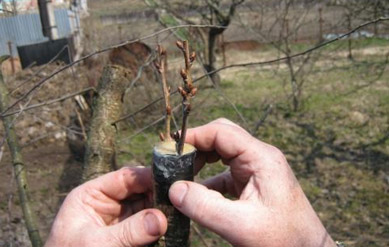
Grafting is the primary method of reproducing fruit trees.
As a result of this treatment, an organism is made of two genetically different parts: scion and rootstock. In practice, several dozen methods of vaccination are known, like for example. vaccination by application, For the starter, in wedge, or for the bark (sheepskin coat). The precondition for good fusion of scion and rootstock is the close connection of their creative tissue (pulp). One way of vaccination is by seeding. It consists in placing an inoculation disc with a leaf bud, a small amount of bark and pulp of a cultivar under the bark of a properly cut rootstock. Budding is the most common method of reproducing fruit trees.