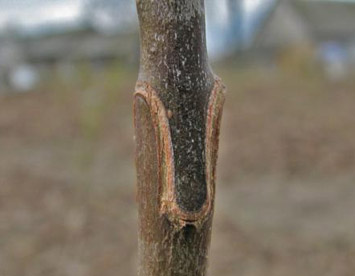
ORDINARY ANTONNA SEEDING (S. ANT). It is a generative rootstock used in Poland for the production of apple trees. It is classified as resistant to frost. It grows well with all apple varieties recommended for cultivation. Apple trees grafted on this rootstock usually begin to bear fruit around the fourth year after planting.
The trees growing on Antonówka seedlings have a strongly developed and deeply reaching root system, thanks to which they grow well and bear fruit in lighter soils.
Currently, approx 60% apple trees. In the coming years, approx 50% Antonówka seedlings will be intended for the production of trees with dwarfing inserts. The remaining number of rootstocks should be used mainly for the production of trees of weak-growing varieties and short-shoot mutants.
ALNARP 2 (A 2). She was selected in Sweden in a year 1920. Currently, it is used in nursery in Scandinavian countries, Poland and Germany. It is resistant to frost. It reproduces well by mounding and is classified as moderately productive. Apple trees grafted on this rootstock grow vigorously at first, during the fruiting period, their growth slows down. Fully fruiting tree crowns reach sizes slightly smaller than apple trees growing on Antonówka seedlings. The trees begin to bear fruit around the fourth year after planting. Washer A 2 it is undemanding to the soil. On lighter soils, the apple trees on this rootstock sometimes show symptoms of magnesium deficiency.
Washer A 2 it is distinguished by a very high resistance to root tuberosity.
It is recommended primarily for the production of trees of low-growing varieties and short-shoot mutants, as well as trees with dwarfing inserts.
MALLING-MERTON 106 (MM 106). It belongs to the group of semi-dwarf rootstocks. She was bred in England. It reproduces very easily by mounding and is classified as moderately productive. In our conditions, it is not very resistant to frost and the MM root system in snow-free conditions 106 may freeze. Young trees grow very strongly, during the fruiting period, their growth slows down. They enter the fruiting period early, usually in the third year after planting and they bear fruit very abundantly.
Based on the research conducted so far, the MM 1Q6 rootstock was considered the most valuable of the semi-dwarf group.
It is recommended primarily for the production of variety trees: Beforest, Idared, Bankruptcy, Delicious and its short shoot mutants, and also Mclntosh, Spartan, Cortland, Lobo, Melba inside.
PATTERN 7 (M 7). It is a typical half-dwarf rootstock widespread in Western Europe and America. It reproduces very easily by mounding and is classified as highly productive. Apple trees grafted on to M 7 initially they grow quite strongly, during the fruiting period, their growth slows down. They enter the fruiting period very early, usually around the third year after planting. On the M washer 7 trees of varieties bear fruit very well: Mclntosh, Spartan, Lobo and Cortland and Bankroft and Close. Usefulness of the M washer 7 despite numerous advantages, it is limited in our country mainly due to its low frost resistance.
PATTERN 4 (M 4). It belongs to the group of semi-dwarfs.
The growth force of apple trees growing on M. 4 depends largely on the fertility of the soil.
On fertile soils with sufficient water supply, the trees grow vigorously and form large crowns. They are then classified as strongly growing. However, on lighter soils, in regions with less rainfall, they grow less and are classified as semi-dwarf. Washer M 4 is widely used for the production of trees in many countries of Western Europe. It reproduces easily by mounding and is classified as moderately productive. It is also quite resistant to frost. Apple trees grafted on to M 4 they begin bearing fruit early, usually in the third year after planting and they bear fruit very abundantly. The usefulness of trees for M. 4 it is limited due to poor rooting and high soil requirements.
PATTERN 26 (M 26). It is a dwarf rootstock bred in England. It was put into production in 1959. It is now quite commonly used in some Western European countries. It reproduces poorly by mounding. It is classified as inefficient. The main advantage of the M 26 is high frost resistance, similar to the strength of Antonówka seedlings.
Trees grafted on M 26 initially they grow quite strongly, when it enters the fruiting period, it becomes weaker. In terms of growth strength, they occupy an intermediate position between trees on rootstock M 9 and trees on a semi-dwarf rootstock M 7. The trees enter the fruiting period very early, in the second or third year after planting and they bear fruit very abundantly. They also have a stronger root system, so they are less demanding on the soil. The trees that bear fruit profusely tilt quite often. All trees on M. 26 it is necessary to stake.
Based on the research carried out so far, the M 26 was considered the most valuable for dwarf orchards.
On the M washer 26 first of all, trees of strongly growing varieties should be produced, such as: Beforest, Bankruptcy, Melrose, Mclntosh, Beautiful view, czy Red King Delicious.
PATTERN 9 (M 9). It is a typical dwarf rootstock, widespread and known all over the world. It reproduces by mounds and is classified as very inefficient.
Apple trees grafted on to M 9 they grow poorly and reach a height of approx 2,0 m. They enter the fruiting period very early, usually in the second or third year after planting. Due to the weak root system, trees grafted on M 9 require fertile soil, warm and rich in water. They should be attached to the stakes during the fruiting period. A major drawback of M. 9 resistance to frost is low. During snowless winters, the root system can freeze easily. That is why the commercial orchards of trees on M 9 can only be installed in areas with permanent snow cover. Trees produced on this rootstock should be intended primarily for allotment and home gardens.