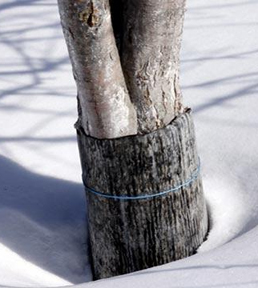
The temperatures in our climate during the plant dormancy and in the first weeks after the beginning of vegetation are the cause of significant cultivation problems. This applies to both maximum temperature drops, in some areas up to approx. -35do temp, and the occurrence of temperatures above 0 ° C in early spring, especially in sunny weather. Tree trunks can then heat up from the south and south–west even to a dozen or so degrees above zero. When the temperature drops significantly at night, they freeze up. Trunks cracking occurs during severe winters, as a result, deep gaps are formed along their entire length. Not only trunks can be damaged by frost, but also other organs of fruit trees and shrubs, both above-ground parts, and the roots. Frost damage to the shoots can be identified on their cross-section, after a darker color. Partially frozen shoots regenerate quite easily. On the damaged trunk or limbs, separation of the bark from the wood is observed. It should be nailed with nails with large heads. On the other hand, open wounds should be smeared with Funaben 3 or emulsion paint with additive 2% Benlate. In the case of very extensive wounds, the so-called. bridge vaccination. Frost damage to the roots is manifested by disturbed plant growth (less foliage, poor gains, and even the death of entire plants). The tree can be saved by implanting wild boars.