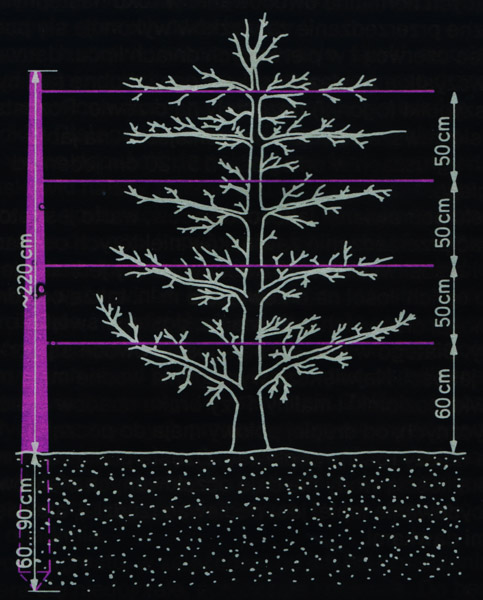
Shaping and translucent cutting of berry bushes is most often performed in the spring, before the beginning of vegetation. The fall term is less recommended, because then there is a risk of frost damage to freshly cut tissues. On the other hand, the X-ray cutting performed immediately after harvesting the fruit is noteworthy. It consists in removing a few skeletal shoots, which will no longer be productive the following year. Then the sun's rays reach the inside of the bushes without any major obstacles. In the lighted and well-ventilated shrub there are less favorable conditions for the development of diseases and pests. In addition, organic and mineral compounds will be used to build flower buds, from which the fruit will arise in the following year. In the spring of the next year, only the excess annual shoots and the ones that are lying on the ground and broken will remain to be removed.
Young black currant bushes produce a lot of shoots, which arise from the root collar and from older shoots. Most of the flower buds are made on long shoots. As the bushes age, the number of long shoots, which ensure high yields of good fruit, is reduced. This is why, among others, black currants are cut in order to cause them to sprout. After planting the bushes, cut all the shoots in one eye above the ground. In the spring of the second, in the third and fourth years, diseased shoots are removed, weak, broken and excessively deviated from the main axis of the bush. However, strong, healthy shoots should be left without shortening. In the spring of the fifth year, all four-year shoots are cut. From younger shoots, similar to the first years of cultivation, diseased shoots should be removed, broken and lying on the ground, and weaker shoots. This blackcurrant pruning has since been used every year. Annually cut blackcurrant bushes should be 5…7 very strong one-year shoots and after 4…5 two-, three- and four years old.
On neglected bushes, which have not been cut for several years, should be removed from 1 /3 do 1 /2 all shoots. After such a strong rejuvenating cut, the bushes can produce too many young shoots; part of these shoots should then be cut close to the ground, leaving only 5…7 the strongest. In the following years, the cutting is carried out like this, as with bushes managed properly.