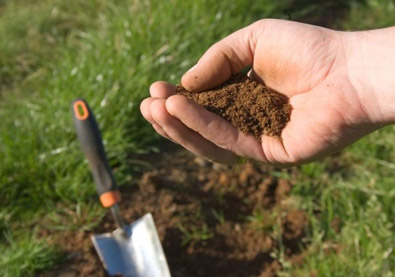
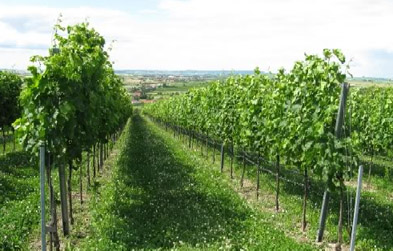
Soils with a shallow arable layer are not suitable for trees and shrubs, on sandy ground, gravel or with a glial layer (brown sand or gravel), which the root system cannot overgrow. In order to check the soil structure and its suitability for orchard cultivation, you must make an opencast – preferably in spring (April May) – digging a hole to a depth of 120…150 cm. Acidity also needs to be checked (pH) soil. A Hellig acid meter is used for this. Put a pinch of soil into the hole of the acid meter plate, Knead it slightly and add a few drops of indicator. After three minutes, tilt the plate like this, so that the indicator reaches the T-shaped groove and accurately compares the color of the solution in the groove with the colors of the scale on the plate. Scale colors, from green to red, correspond to pH values from 8 do 4.
On alkaline soils (pH above 7,2) or indifferent (pH 6,6…7,2) pear trees should not be planted, raspberries and strawberries. These soils are best suited for walnuts, but plums and apple trees can also bear fruit. The vast majority of fruit plants require slightly acidic soil (pH 5,5…6,6). Only highbush blueberry and cranberry need acidic soil (pH 3,8…4,8). However, soil acidification is practically impossible. Conversely, if the soil is too acidic (low pH), its acidity can be reduced by liming. For this purpose, fast-acting calcium oxide is used on heavy soils (High). However, on light soils, calcium carbonate should be used (CaCO3), as slower (longer mineralizes organic compounds). Calcium carbonate is also used for soil liming shortly before planting. Oxide is corrosive.
For soil liming, it is most advisable to use magnesium lime, because most of the soils (especially light) has a low magnesium content .