SEEDING OF CAUCASIAN PEAR. These are currently the most commonly used rootstocks for the production of pear trees in nurseries. There are many different forms of the Caucasian pear, therefore, the rootstocks obtained from seeds are characterized by a large variability of characteristics. Caucasian pear seedlings are classified as frost-resistant and resistant to brown blotch leaves.. On these rootstocks, poorly growing pear varieties grow well and bear fruit. Strongly growing varieties form large crowns and begin bearing fruit late.
Despite these disadvantages, approx 90% pear trees are currently grown on the seedlings of the Caucasian pear tree.
BEAT UP. It is the most common rootstock for pear trees in the world. It reproduces very easily by mounding and is classified as very productive. However, among the used rootstocks for fruit trees, it is the most sensitive to frost. For this reason, its share in the production of pear trees in Poland is small. In addition, the quince grows badly with some pear varieties recommended for cultivation. For varieties that grow badly with quince, such as: Colorful Lipcówka, The favorite and Bonkret Williams, it is necessary to use an intermediate one – Barry Hardego. Many types of quinces are known. The Mailing A quince is the most common in Poland (MA) and quince S. (selection by Eng. Somorowski). Both are among the semi-dwarf rootstocks that produce quite early (around the fourth year) fruiting of vaccinated pear varieties. In recent years, several thousand of the least-growing quinces, Mailing C, have been imported from abroad (MC).
Pears grafted on various quince clones require fertile soils with well-regulated water conditions. They fail completely in light and sandy soils.
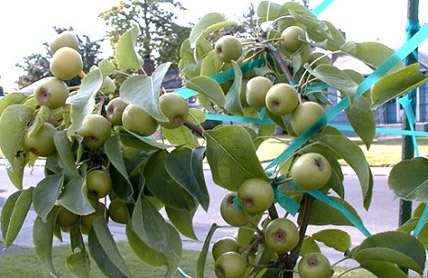 SEEDING OF CAUCASIAN PEAR. These are currently the most commonly used rootstocks for the production of pear trees in nurseries. There are many different forms of the Caucasian pear, therefore, the rootstocks obtained from seeds are characterized by a large variability of characteristics. Caucasian pear seedlings are classified as frost-resistant and resistant to brown blotch leaves.. On these rootstocks, poorly growing pear varieties grow well and bear fruit. Strongly growing varieties form large crowns and begin bearing fruit late.